The Essential Chomsky by Noam Chomsky Anthony Arnove
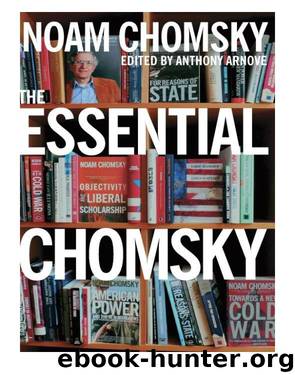
Author:Noam Chomsky, Anthony Arnove
Language: eng
Format: epub
ISBN: 9781595585660
Publisher: New Press, The
that is, the mildly reformist capitalism of the New Deal. The scale of business public relations campaigns, Bell continued, was “staggering,” through advertising in press and radio and other means.17 The effects were seen in legislation to constrain union activity, the attack on independent thought often mislabeled McCarthyism, and the elimination of any articulate challenge to business domination. The media and intellectual community cooperated with enthusiasm. The universities, in particular, were purged, and remained so until the “crisis of democracy” dawned and students and younger faculty began to ask the wrong kinds of questions. That elicited a renewed though less effective purge, while in a further resort to “necessary illusion,” it was claimed, and still is, that the universities were virtually taken over by left-wing totalitarians—meaning that the grip of orthodoxy was somewhat relaxed.18
As early as 1947, a State Department public relations officer remarked that “smart public relations [has] paid off as it has before and will again.” Public opinion “is not moving to the right, it has been moved—cleverly—to the right.” “While the rest of the world has moved to the left, has admitted labor into government, has passed liberalized legislation, the United States has become anti-social change, anti-economic change, anti-labor.” 19
By that time, “the rest of the world” was being subjected to similar pressures, as the Truman administration, reflecting the concerns of the business community, acted vigorously to arrest such tendencies in Europe, Japan, and elsewhere, through means ranging from extreme violence to control of desperately needed food, diplomatic pressures, and a wide range of other devices.20
All of this is much too little understood, but I cannot pursue it properly here. Throughout the modern period, measures to control “the public mind” have been employed to enhance the natural pressures of the “free market,” the domestic counterpart to intervention in the global system.
It is worthy of note that with all the talk of liberal free trade policies, the two major sectors of the U.S. economy that remain competitive in world trade—high-technology industry and capital-intensive agriculture—both rely heavily on state subsidy and a state-guaranteed market.21 As in other industrial societies, the U.S. economy had developed in earlier years through protectionist measures. In the postwar period, the United States grandly proclaimed liberal principles on the assumption that U.S. investors would prevail in any competition, a plausible expectation in the light of the economic realities of the time, and one that was fulfilled for many years. For similar reasons, Great Britain had been a passionate advocate of free trade during the period of its hegemony, abandoning these doctrines and the lofty rhetoric that accompanied them in the interwar period, when it could not withstand competition from Japan. The United States is pursuing much the same course today in the face of similar challenges, which were quite unexpected forty years ago, indeed until the Vietnam War. Its unanticipated costs weakened the U.S. economy while strengthening its industrial rivals, who enriched themselves through their participation in the destruction of Indochina. South Korea owes its
Download
This site does not store any files on its server. We only index and link to content provided by other sites. Please contact the content providers to delete copyright contents if any and email us, we'll remove relevant links or contents immediately.
The Secret History by Donna Tartt(18971)
The Social Justice Warrior Handbook by Lisa De Pasquale(12172)
Thirteen Reasons Why by Jay Asher(8856)
This Is How You Lose Her by Junot Diaz(6845)
Weapons of Math Destruction by Cathy O'Neil(6225)
Zero to One by Peter Thiel(5743)
Beartown by Fredrik Backman(5691)
The Myth of the Strong Leader by Archie Brown(5474)
The Fire Next Time by James Baldwin(5395)
How Democracies Die by Steven Levitsky & Daniel Ziblatt(5183)
Promise Me, Dad by Joe Biden(5120)
Stone's Rules by Roger Stone(5060)
A Higher Loyalty: Truth, Lies, and Leadership by James Comey(4921)
100 Deadly Skills by Clint Emerson(4888)
Rise and Kill First by Ronen Bergman(4747)
Secrecy World by Jake Bernstein(4710)
The David Icke Guide to the Global Conspiracy (and how to end it) by David Icke(4664)
The Farm by Tom Rob Smith(4475)
The Doomsday Machine by Daniel Ellsberg(4463)
